
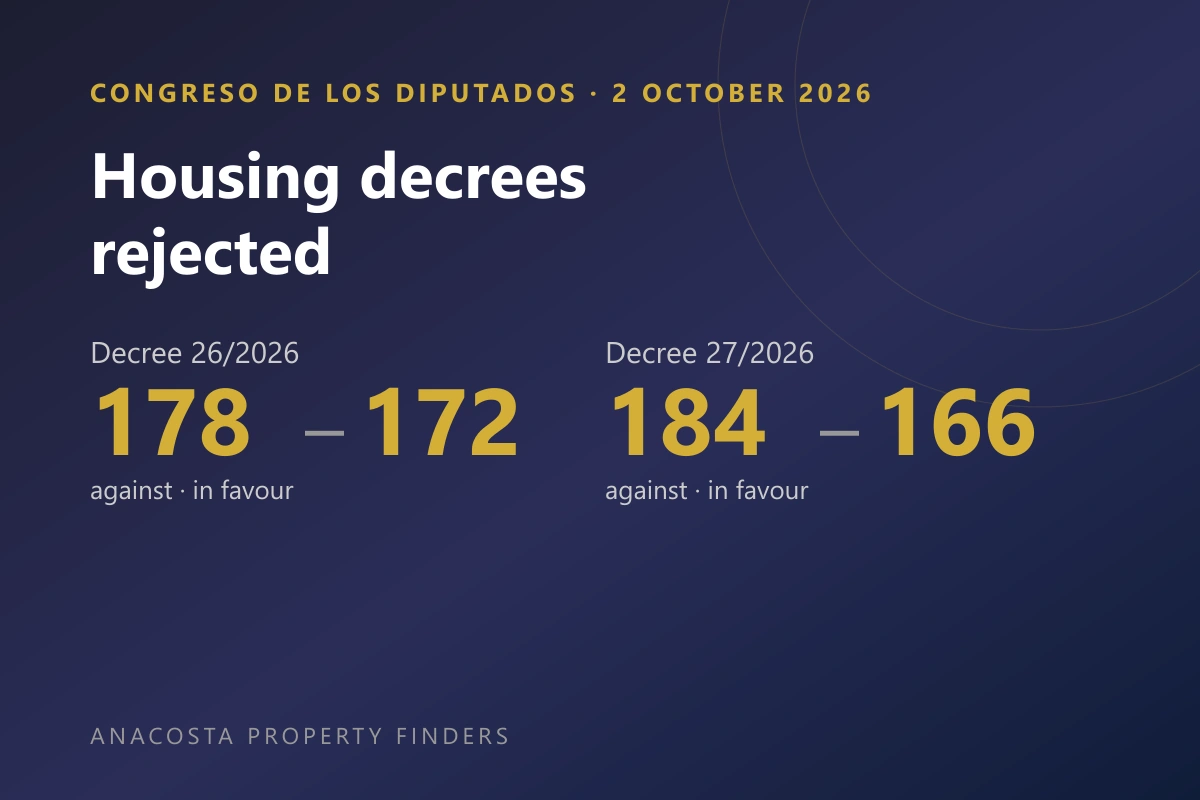
On Friday 2 October, the Spanish Parliament voted down two emergency decrees from the Sánchez government intended to tackle the housing crisis. Outside the parliament building in Madrid, hundreds of protesters reacted angrily, while a chant rang out from the public gallery: “Los fondos buitre gobiernan el Congreso” — “Vulture funds rule Parliament”. What did the plans contain, why were they defeated, and what does this mean for you as a current or prospective property owner on the Costa Blanca or Costa Cálida?

The background: an eviction that struck a chord across Spain
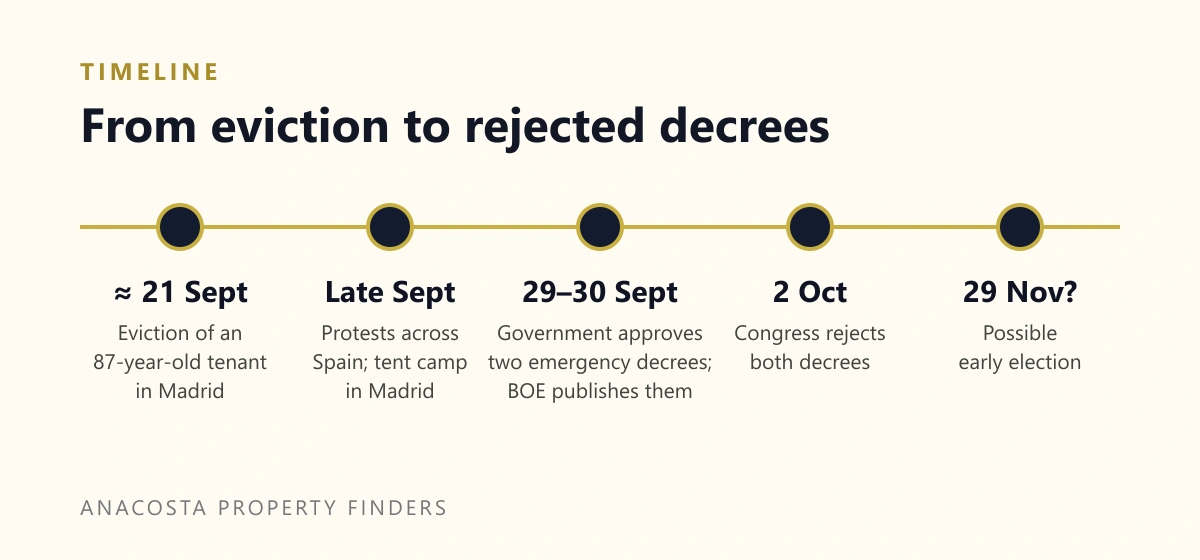
The housing crisis has been at the top of Spain’s political agenda since an 87-year-old woman in Madrid was evicted from her rented home in late September, after living there for around seventy years. Her case became a symbol of growing dissatisfaction with a housing market that is becoming unaffordable for more and more Spaniards.

Thousands of people took to the streets. A tent encampment sprang up in Madrid’s Puerta del Sol, organised by groups including the tenants’ union Sindicato de Inquilinas. The woman’s eviction has since been reversed, but the anger remains.
To contain the protests, the government approved two royal emergency decrees (reales decretos-ley) on 29 September, which took effect immediately after publication in the official state gazette (BOE). An emergency decree of this kind must be ratified by Congress within thirty days. That is where these measures failed.
The vote: Junts tips the balance
The left-wing minority government of PSOE and Sumar failed to secure a majority for the plans. Alongside the right-wing opposition parties, Partido Popular and Vox, the Catalan separatist party Junts also voted against them. Earlier in the week, Junts had already announced that it would not support either decree, effectively sealing the measures’ fate.
The results in Congress
350 seats · Friday 2 October 2026
against: PP, Vox, Junts, UPN
PNV and Coalición Canaria also voted against
Prime Minister Pedro Sánchez had warned those voting against the measures that “history will judge them”. Following the defeat, Spanish newspapers including El Mundo and El País report that he is considering calling an early election to turn dissatisfaction with the vote into electoral support. 29 November has been mentioned as a possible date. The tenants’ union announced demonstrations in more than fifty cities and even spoke of a general strike.
What did the two decrees contain?
The packages were wide-ranging, affecting tenants, landlords, investors and holiday home owners. Their main provisions were:
Greater protection for tenants
A ban on evicting vulnerable households without alternative accommodation, extended until 31 December 2030. Tenancies ending before the end of 2028 could, subject to conditions, have been extended by two years, with a limited rent increase. The second decree sought to make extensions largely automatic, with compensation for tenants if the landlord refused to extend without a valid reason.
Tougher rules for large investors
Restrictions on speculative purchases by so-called fondos buitre (large property investment funds) until the end of 2028, alongside tax changes for listed property investment companies (SOCIMIs).
Tourist rentals: 10% VAT and a maximum of 31 days
From 1 December 2026, tourist rentals of a property that is not the owner’s main residence (stays of up to 30 nights) would have attracted 10% VAT. Since 1 October, tourist rentals had also been limited to 31 days. Municipalities in ‘stressed’ housing markets would have been allowed to impose an IBI surcharge (property tax) of 50% to 150% on holiday rental properties.
Seasonal and room rentals, alongside tax incentives
Stricter rules for temporary tenancies and room rentals, tax relief for tenants and small private landlords, and a reduced VAT rate of 4% for the construction of social housing for rent.
With both decrees rejected, all these measures lapse, including the provisions that had already been in force since 30 September.
What does this mean for you as a buyer or owner?
You let, or plan to let, your property to tourists
For now, nothing changes compared with the position before 30 September. The 10% VAT rate and IBI surcharge will not go ahead, and the 31-day limit has lapsed. The proposal for 21% VAT that we wrote about in July had already been watered down to 10% in the decrees and is now off the table altogether. What does remain in force is the regional tourist rental licence, the national rental registration number, guest registration through SES Hospedajes, and the rule allowing the owners’ association (comunidad de propietarios) to prohibit new tourist rentals with a three-fifths majority.
Do expect the subject to return. The government has made clear that it wants to increase the tax burden on tourist rentals. If you are buying a property with plans to let it out, it is sensible to include a VAT scenario in your yield calculations; our Investment Check can help.
You let your property on a long-term basis
The additional rights to tenancy extensions and the limits on rent increases will not go ahead. Spain’s existing tenancy law (LAU) continues to apply. The promised tax relief for small landlords also falls away.
You are looking for a property on the coast
The anti-speculation measures targeted large investors and funds, rather than private individuals buying a second home. For most of our clients, the vote therefore has little direct effect on the purchase itself. The housing crisis is particularly acute in Madrid, Barcelona, the islands and major cities. Prices are also rising on the Costa Blanca, but the pressures there are different in nature.
What does change is the political uncertainty. If an election is called, policy on tenancies and tourist rentals could move in any direction. That is why we continue to follow developments for you. We routinely take them into account in our buyer’s guidance.
Our honest view as your buyer’s agent
We would not postpone a sound purchase because of this vote, nor would we rush it. For a private buyer, what happened on 2 October changes little about the property itself. It does, however, change the uncertainty surrounding rentals. If letting is part of your reason for buying, do not base your decision on the most favourable scenario: choose a property that still makes sense under stricter rules.
Questions to ask yourself if you plan to let
✔ Does my yield still add up if VAT is introduced on holiday rentals later?
✔ Does the property have, or can it obtain, a regional tourist rental licence?
✔ Does the owners’ association allow tourist rentals, and how likely is that to change?
✔ What if I have to let on a long-term basis under Spain’s tenancy law (LAU)?
✔ Would I still buy this property without rental income?
What happens next?
The government has several options: introduce new, amended decrees that can command a majority, turn the measures into a normal bill, which would take months, or go to the electorate. The official state gazette (BOE) has now published the repeal of both decrees.
For owners and buyers, the message is therefore: do not panic, but stay alert. We will update this article as soon as new plans or an election date emerge.
Please note: this article was written on 2 October 2026, the day of the vote. The political situation can change quickly. Always check the current rules for your own circumstances with a gestoría, abogado or tax adviser.
More on buying and letting property in Spain
Frequently asked questions
Do I have to charge 10% VAT on my holiday rentals from 1 December?
Does the maximum rental period of 31 days still apply?
Could these measures return?
Is this a reason to postpone buying a property in Spain?
Unsure about buying or letting property in Spain?
We follow legislation and regulations closely and routinely consider rental opportunities, licences and risks as part of our buyer’s guidance. Tell us your plans and we will help you think them through. Independently, without sales pressure and solely in your interests.