
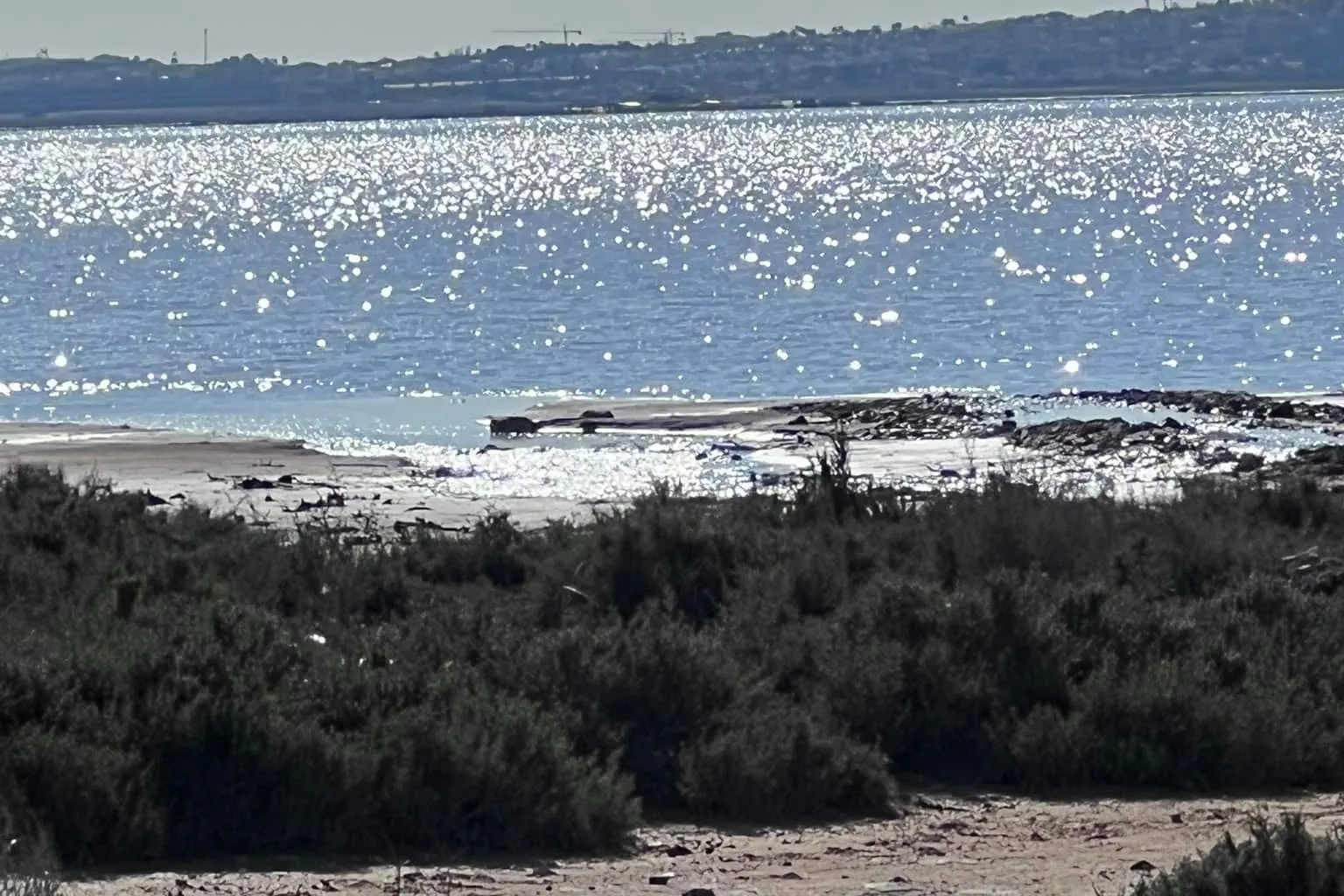
The salt lakes of Torrevieja are the most recognisable sight on the southern Costa Blanca: a lagoon so pink it can be seen from space. What many visitors do not realise is that this is not a natural curiosity on its own but a working salt factory — the largest producer of sea salt in Europe, turning out some 600,000 tonnes a year. You can get right into the middle of it on the tourist train. This guide covers how that works, what it costs, and what to watch out for.
Two lagoons, one natural park
The Lagunas de La Mata y Torrevieja natural park consists of two lakes. The Laguna Salada de Torrevieja is the famous pink one; the Laguna de La Mata beside it is greener and serves as an evaporation basin. Together they have been protected since 1988 and form part of a network of seven salt flats in the province of Alicante.
The pink is neither a filter nor an algal bloom. It comes from micro-organisms that survive only in extremely salty water — chiefly the alga Dunaliella salina and salt-loving bacteria — which produce red and pink pigments. The saltier, warmer and sunnier it is, the more intense the colour. The effect peaks in late spring and summer.
The salt: 600,000 tonnes a year
Salt has been produced here since the time of the Catholic Monarchs, and the operation is still in full swing. The white mountains you see from the road are not scenery: the salt is harvested, stacked and shipped out. Torrevieja is also the only salt works in the world with its own extraction system.
One detail on the information board by the lagoon that almost nobody knows: since 1970 the salt from Torrevieja has no longer been 100% sea salt. In that year a brine pipeline was built carrying brine from the salt dome at Pinoso, more than sixty kilometres inland. That brine is mixed here with pre-concentrated seawater from the Laguna de La Mata.


The salt boats: a tradition that has almost disappeared
There is one thing here you will not see anywhere else in the world. Every year, salt workers from Torrevieja build ship models out of wood and rope — full three-masters, complete with masts, yards and rigging. They spend months on them, and in summer the models are placed in the lagoon.
The salt does the rest. The extremely saline water slowly crystallises onto the ropes and the hull until the whole ship is encased in a white crust. What remains is no longer a model but a sculpture, made by the lake itself.

These barcos de sal were once the souvenir of Torrevieja, sold everywhere. Today they are a rarity, simply because hardly anyone can still make them. Which is precisely why they are worth seeking out if you are here in summer.


Through the salinas by train
The easiest way to get right into the heart of it is the tourist train. It runs into the natural park, past the old crystallisation basins, the salt mountains and the pink lagoon, with a stop in the middle of the salinas and at the shop.
| Practical | |
|---|---|
| Departure point | Paseo de la Libertad, central Torrevieja, next to the harbour |
| Duration | About 1 hour 15 minutes, including stops |
| Minimum | The train only leaves with six passengers |
| Tickets | At the ticket office on the Paseo de la Libertad or on board |
| Closed | Usually Mondays |
| Departure times | Vary by month — check the website beforehand |
Prices
Indicative, as of 2026 — subject to change
The family ticket is only available at the ticket office, not online. Group rates require booking in advance. Times and prices vary by season; check visitasalinasdetorrevieja.com before you set off.

AnaCosta Tip
Note that two different tourist trains operate in Torrevieja. One goes into the salinas, the other does a town and beach route along the promenade. They leave from different points and cost different amounts. If you want to see the salt lakes, ask specifically for the train to the salinas.
On foot, by bike or with a guide
The train is not the only option. Freely accessible paths run around the lagoons where you can walk and cycle, with viewpoints and bird hides. That costs nothing, and early morning or towards sunset is when it is at its most beautiful — and quietest.
Guided walking tours are also available, and even an evening tasting of salt-cured fish and wine overlooking the lagoon. That last one is by reservation only.

What you will see
- the pink lagoon, varying in intensity by season
- the salt mountains, partly covered with white sheeting
- the old crystallisation basins of the former chemical plant
- the extraction plant with its conveyors and cranes
- flamingos and thousands of other water birds — this is an internationally recognised wetland
- salt crusts and crystals along the shore

What you may not do
One thing matters before you go: bathing and swimming in the lagoon are officially prohibited. It is a protected natural area, machinery operates below the surface, and fines run to several hundred euros.
Enforcement is patchy, so in summer you will always see people standing knee-deep in the water. That does not make it permitted — and it is not without risk. Walking along the edge and taking in the view is what you come for.
Also: wear comfortable shoes and bring sun protection. There is almost no shade, and the white of the salt reflects considerably.
Living next to a natural park
For anyone considering a property in Torrevieja, this area is more than a day out. The neighbourhoods on the lagoon side — Los Balcones, Torreta, the zone towards La Mata — back onto protected land. That brings a practical advantage which is often overlooked: nothing more can be built there. A view over the natural park stays a view over the natural park.
Against that, you are further from the centre and it can be very quiet out of season. What one person calls peaceful, another calls remote. So visit in August and again in January before you decide. Our page on buying with a buyer’s agent on the Costa Blanca explains how we approach that.
Useful to know before you visit
✔ Go late afternoon — best light, least heat
✔ May to September gives the strongest pink
✔ The train only runs with a minimum of six passengers
✔ Mondays are usually a rest day
✔ Comfortable shoes, a cap and sunscreen
✔ Bathing is prohibited — even if you see others doing it
✔ Bring binoculars for the flamingos
More about Torrevieja and the region
Looking for a property in Torrevieja?
We do not sell properties — we help you buy the right one. Independent, and only in your interest.
Looking for a village setting near this landscape, rather than a home in the coastal town? Also explore living in Los Montesinos. Compare the specific location and your daily routes.
Could the salt-lake landscape be part of your everyday life? Compare Torrevieja’s neighbourhoods and current listings before choosing between a central apartment and a home closer to the lagoons.
Frequently asked questions
How much does the train through the salt lakes cost?
Where does the train leave from?
Can you swim in the pink lagoon?
How much salt is produced here?
When is the lagoon at its pinkest?
Considering Torrevieja or the southern Costa Blanca?
We guide you independently through the entire buying process: from the first search to the handover of the keys. No sales pressure, no hidden commissions.